
Table of Contents
Will capital gains tax changes crash house prices or just slow growth?
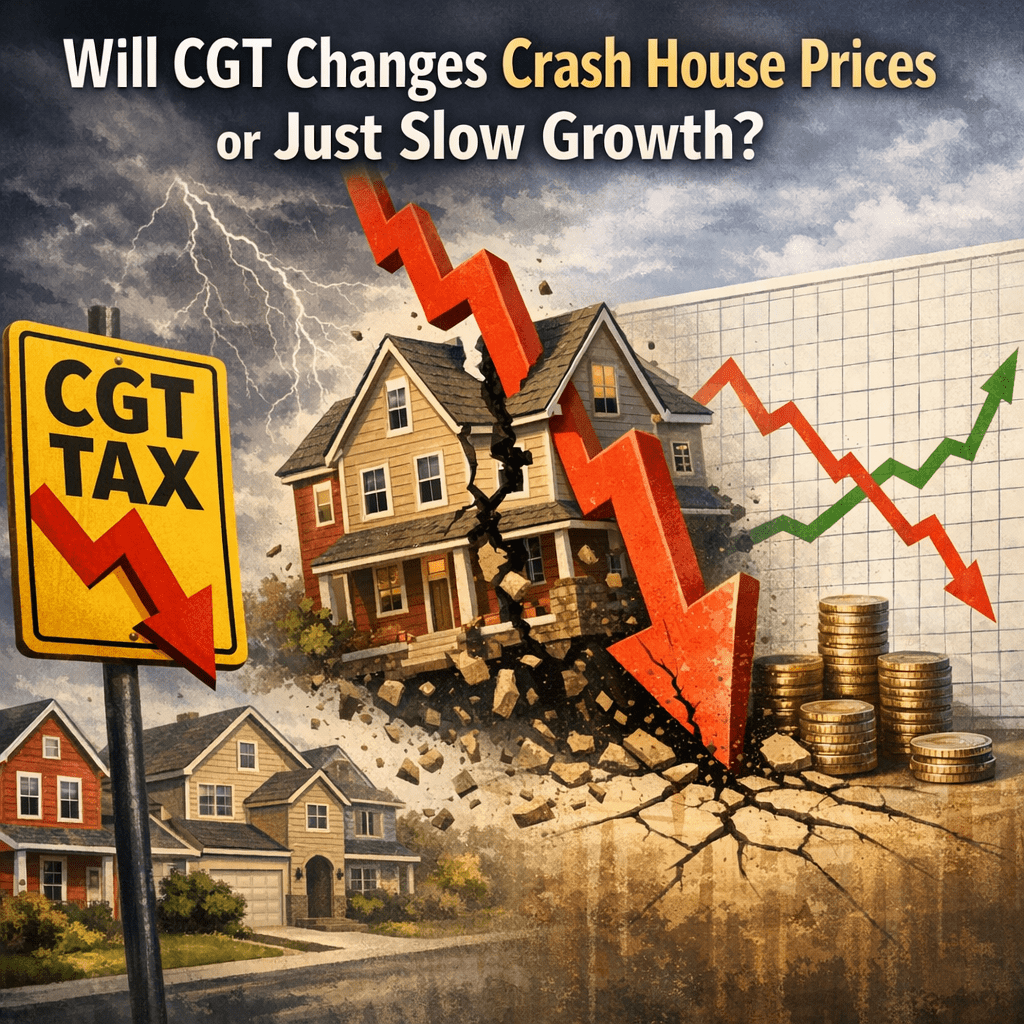
Capital Gains Tax (CGT) changes often trigger dramatic headlines: “Investors will flee”, “The market will crash”, “House prices will plunge”. The reality is usually less explosive—and more nuanced. The impact of capital gains tax changes can be profound on the property market.
CGT matters because it changes the after-tax return from property investment. But house prices are not set by tax policy alone and capital gains tax changes. They’re shaped by a web of forces: interest rates, wages, housing supply, population growth, planning rules, credit availability, and sentiment. A CGT increase can cool parts of the market, shift investor behaviour, and change the balance between owner-occupiers and landlords—but whether that translates into a “crash” depends on the size and structure of the policy change, and the wider economic backdrop.
This post explores the mechanics: when capital gains tax changes could cause sharp falls, when they’re more likely to slow growth, and what it could mean for buyers, sellers, and renters.
What capital gains tax changes are (and why they matter for housing)
CGT is generally paid on the profit you make when you sell an asset that has risen in value—often including second homes, buy-to-let properties, and investment properties (with exemptions and reliefs varying by country and circumstance). The capital gains tax changes can significantly impact these transactions.
In simple terms:
- Profit (gain) = Sale price ? Purchase price ? Allowable costs (e.g., improvements, some fees)
- Tax payable = Gain × CGT rate (after any allowances/reliefs)
For many owner-occupiers, the primary home is often exempt (again depending on jurisdiction). That means capital gains tax changes tend to land most heavily on:
- Buy-to-let landlords
- Second-home owners
- Property “traders” and serial renovators
- Investors using property as a long-term wealth asset
The key insight: CGT is a tax on exit. It affects the decision to sell (timing) more directly than the decision to buy—though it influences both. Overall, capital gains tax changes can lead to significant shifts in the property market.
The channels through which capital gains tax changes affect house prices
1) Investors may demand a higher pre-tax return
If CGT rises, the after-tax profit from future price appreciation falls. Investors then typically respond in one (or more) of these ways:
- Offer lower prices for properties they’re bidding on (reducing demand)
- Switch to other assets (shares, bonds, commercial property) if relative returns improve
- Focus more on rental yield rather than capital growth
- Reduce leverage if the overall return feels less compelling
In markets where investors are a major share of buyers (certain city centres, rental-heavy suburbs, “yield plays”), this can noticeably cool prices and capital gains tax changes can exacerbate this effect.
2) Some owners rush to sell before the new rate kicks in
When a capital gains tax increase is announced with a future start date, it can create a short-term surge in listings and transactions:
- Investors accelerate sales to lock in the lower rate.
- Buyers (especially other investors) might also pull purchases forward.
This can lead to a brief boom-bust pattern: activity spikes, then drops. Prices may wobble during the adjustment, but it often looks more like volatility than a sustained crash—unless the broader economy is already fragile.
3) “Lock-in” effects can reduce supply
Paradoxically, higher CGT can also reduce the number of properties for sale. If selling triggers a large tax bill, owners may hold on longer to avoid crystallising gains, especially in the context of capital gains tax changes.
This “lock-in” effect can:
- Reduce transaction volumes
- Tighten supply in some segments
- Support prices (or at least prevent sharp falls), especially where housing is already scarce
So CGT can cool demand and reduce supply—two forces that can partially offset each other in price terms while still reducing market activity. The interplay of these capital gains tax changes creates a complex market environment.
4) Landlords may pass some costs into rents (but only if the market allows)
CGT is paid on sale, not on ongoing rental income. Still, if the overall attractiveness of being a landlord declines (especially alongside other taxes and regulations), fewer landlords may enter or stay in the market.
If rental supply falls faster than demand for renting, rents can rise—but only where tenants can afford higher prices. In weaker local economies, landlords may be unable to pass costs on.
5) Developers and renovations can slow if “end prices” soften
In many markets, small-scale developers and renovators rely on the spread between:
- acquisition cost + works + financing, and
- the resale price (after tax)
If capital gains tax changes reduce the expected after-tax margin, some projects won’t stack up, potentially:
- lowering renovation activity,
- reducing improved housing stock coming to market,
- and slowing neighbourhood “uplift” dynamics.
A simple numerical example: why capital gains tax changes can cool bids
Imagine an investor buys a rental property and expects it to rise from £300,000 to £360,000 over time.
- Gain = $60,000 (ignoring costs/allowances for simplicity)
If CGT is 20%, tax is $12,000, leaving $48,000 after tax.
If capital gains tax changes and CGT rises to 30%, tax becomes $18,000, leaving $42,000 after tax.
That’s a 12.5% drop in after-tax gain ($48k ? $42k), which can translate into lower willingness to pay today—especially if rental yield is modest and most of the expected return is capital appreciation.
But note the bigger picture: investors don’t set prices alone. In many areas, owner-occupiers dominate demand, and they aren’t directly affected by CGT on their main home.
When capital gains tax changes could cause a sharp drop (or localised “crash”)
A broad, national crash is possible, but it’s not the base case. It becomes more plausible when capital gains tax changes coincide with other stressors.
1) If investors are the marginal buyer in that segment
The “marginal buyer” is the one who sets the price at the margin. If the marginal buyer is an investor (common in:
- small flats,
- city-centre apartments,
- student or short-let hotspots,
- areas with heavy landlord ownership),
then a reduction in investor demand due to capital gains tax changes can lead to faster price corrections.
2) If the policy is sudden, large, and unavoidable
Markets absorb gradual changes. They struggle more with:
- large rate jumps,
- removal of key reliefs,
- retrospective elements (rare, but disruptive),
- or complex rules that create uncertainty.
Uncertainty itself can freeze buyers and sellers, which can push prices down temporarily if forced sellers appear.
3) If interest rates or credit conditions are also tightening
Historically, interest rates and mortgage availability have been much more powerful drivers of house prices than CGT. Capital gains tax changes can contribute to this dynamic.
If CGT rises at the same time as:
- mortgage rates climb,
- affordability worsens,
- lenders reduce risk appetite,
- or unemployment rises,
then the tax change can become the extra push that turns a slowdown into a sharper fall.
4) If there’s already oversupply in a specific market
Some locations—often those that built many similar units quickly—are more vulnerable. If an area already has:
- high vacancy,
- lots of new-build completions,
- or weakening tenant demand,
then investor selling triggered by capital gains tax changes can amplify a downward move.
Why the more likely outcome is slower growth, not a crash
1) Owner-occupier demand is driven by fundamentals
Most homebuyers purchase to live in the property. Their main drivers are:
- monthly mortgage costs,
- income expectations,
- family needs,
- and local amenities.
Capital gains tax changes can indirectly influence them (via broader market sentiment), but it’s rarely the decisive factor.
2) Supply constraints often dominate
In many countries—particularly where planning restrictions, slow permitting, and limited land availability constrain building—housing supply doesn’t respond quickly. When supply is structurally tight, it’s difficult to engineer a large, sustained price fall through a single tax lever, including capital gains tax changes.
CGT changes may reduce froth, shorten bidding wars, and cool the top end—but a “crash” typically requires either excess supply or a severe demand shock.
3) Lock-in effects can stabilise prices
As mentioned, higher CGT can discourage selling. If fewer landlords list properties, the increased supply that would otherwise push prices down may not materialise.
The market can end up with:
- lower transaction volumes (fewer sales),
- longer time on market,
- more negotiation,
- but only modest price declines, especially outside investor-heavy pockets.
4) Policy is often designed to avoid destabilisation
Governments rarely want to spark a housing crash. Even when they aim to re-balance housing markets, they often:
- phase changes in,
- provide transitional rules,
- retain some reliefs,
- or set thresholds/allowances.
That reduces the chance of a sudden cliff-edge due to capital gains tax changes.
What different groups might do in response
Landlords and property investors
Common responses include:
- Selling lower-performing properties (low yield, high maintenance)
- Holding on longer to defer tax (“lock-in”)
- Shifting to higher-yield areas (regional towns over prime cities)
- Incorporating or restructuring ownership (depending on tax rules)
- Focusing on value-add (renovation, extensions) if allowable costs reduce taxable gain
The likely market effect: rotation—not a mass exit everywhere caused by capital gains tax changes.
First-time buyers and owner-occupiers
If investor demand softens in entry-level segments (e.g., small flats), first-time buyers may see:
- less competition,
- fewer cash buyers,
- and slightly improved negotiating power.
However, affordability still hinges far more on mortgage rates and income.
Sellers
Sellers who are investors face a key choice: sell now and crystallise gains, or hold. In markets where many sellers choose “now,” you may see a temporary increase in listings. But if many choose “hold,” supply can tighten due to capital gains tax changes.
Either way, expect more price sensitivity: fewer buyers willing to “stretch.”
Renters
Rent outcomes depend on local supply-demand. Potential impacts include:
- upward rent pressure where landlords sell and rental stock shrinks,
- limited rent growth where tenant affordability is capped,
- and changes in quality if fewer landlords invest in improvements due to capital gains tax changes.
A key point: policy aimed at lowering house prices can unintentionally raise rents if it reduces rental supply faster than it increases owner-occupier access.
Likely market outcomes: three scenarios
Scenario A: “Slowdown and flattening” (most common)
- Transactions fall
- Investor-heavy segments soften
- House price growth slows or goes flat for a period
- Prime family homes remain resilient if supply is tight
This is what many capital gains tax changes produce: less heat, not a crash.
Scenario B: “Short-term volatility, then normalization”
- Rush to sell before implementation
- Brief dip after the deadline as activity drops
- Market stabilises once new pricing expectations settle
This is especially likely when capital gains tax changes are announced well in advance.
Scenario C: “Sharp correction in specific pockets”
- City-centre flats, second-home areas, or oversupplied developments fall more
- Broader market sees only mild declines
This is the “localised crash” version—plausible if investors dominate and fundamentals are weaker.
How to think about capital gains tax changes as a buyer or seller
If you’re buying to live in the home
Focus on fundamentals:
- Can you comfortably afford the payments at today’s rates (and with a buffer)?
- Are you planning to stay long enough to ride out short-term volatility?
- Is local supply constrained?
Capital gains tax changes may improve your negotiating position in some segments, but they’re unlikely to transform affordability on their own.
If you’re selling an investment property
Consider:
- whether there’s likely to be a pre-change selling rush (more competition),
- how much of your market is investor-driven,
- and whether holding longer meaningfully improves outcomes after tax.
Sometimes the best decision is operational rather than tax-driven: sell assets that no longer perform, and keep those with strong yields and low hassle, especially in light of capital gains tax changes.
If you’re a renter
Watch the landlord mix in your area. If many rentals are owned by small landlords and policy pressures are pushing them out, rental supply can tighten. Longer leases, early renewals, or widening your search area may help manage risk.
Conclusion: crash is possible, but slowdown is more probable
Capital gains tax changes can cool housing markets by reducing after-tax investment returns, shifting investor demand, and changing selling behaviour. But a nationwide crash usually requires more than CGT alone—typically a combination of tighter credit, higher interest rates, rising unemployment, or oversupply.
The more likely outcome is slower growth, fewer transactions, and localised softness—especially in investor-heavy segments—rather than a broad collapse. If you want to judge the real risk, look beyond the tax headline and ask: Who buys in this market, how tight is supply, and what are interest rates doing?
Does this affect my family home?
Your main home is generally CGT-exempt, but there are exceptions (like renting part out or special situations).
Will CGT changes crash Gold Coast prices?
Most mainstream modelling discussed in public points to smaller price effects than headlines suggest, especially compared to supply issues.
- Selling Near Bond University: Exclusive Varsity Lakes House Prices Analysis 2026
- Gold Coast Waterfront Sellers: Must-Know 14-Day Rule for Fast Sales
- Robina Property Market 2026: Exclusive Insights for Gold Coast QLD
- Robina Seller Mistakes That Cost Tens of Thousands to Avoid Now
- How to Price My House to Sell Gold Coast: Avoid Costly Pricing Mistakes
https://www.abc.net.au/news/2026-02-06/would-higher-property-taxes-mean-lower-house-prices/106311582?utm_source=chatgpt.com
https://conradhyslop.com/viral-real-estate-videos-australia-truth/ https://conradhyslop.com/viral-real-estate-videos-australia-truth