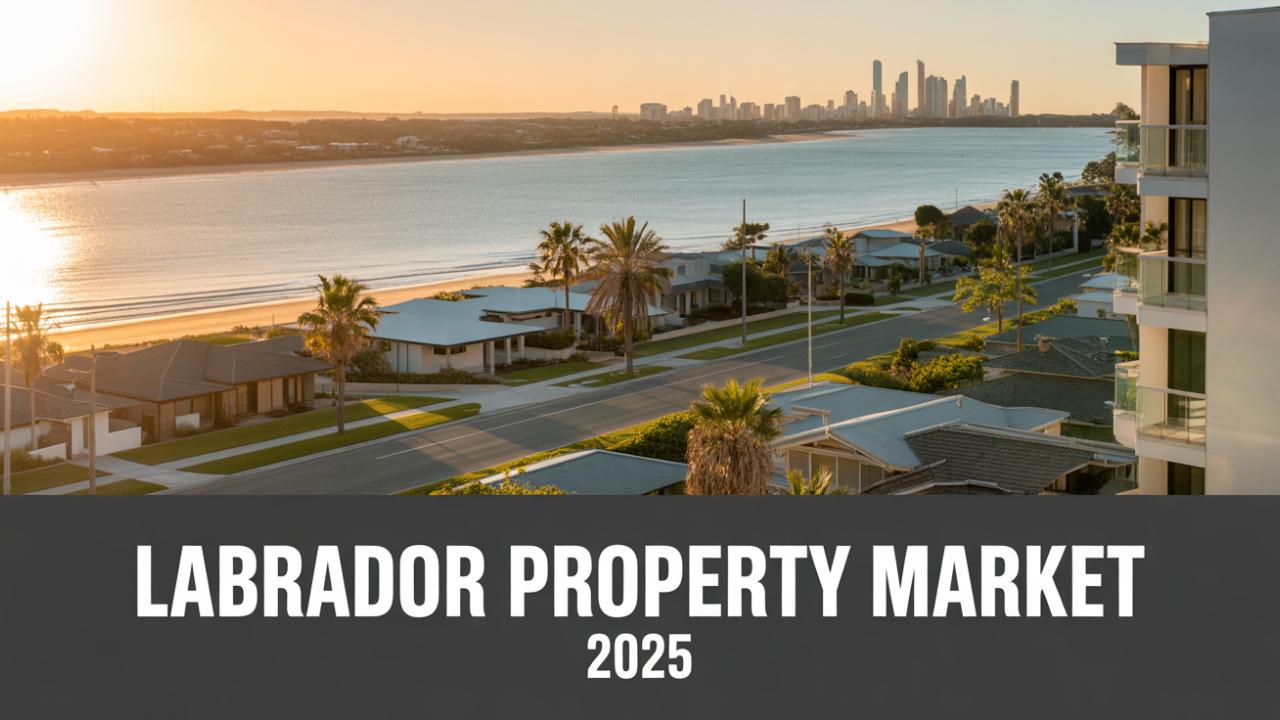
Welcome to the Labrador 2025 Property Market Update – where facts meet a bit of fun. If you’re a property owner or potential seller in Labrador (Gold Coast), this update is for you. We’ll dive into fresh, suburb-specific data, compare Labrador’s performance with neighbours like Southport, Runaway Bay, and Biggera Waters, and unpack what’s driving buyers and sellers. No fluffy clichés here – just real insights (with a pinch of humor) to help you make informed decisions.
Labrador at a Glance in 2025
Labrador has officially entered the Gold Coast’s “million-dollar club” for house values. Median house prices in the suburb sit around $1.1 million as of mid-2025, which is about a 10% jump from last year. In fact, one analysis shows Labrador’s median house value rising from roughly $979k in 2024 to $1.077M in 2025. That’s a solid gain, outpacing many suburbs. Units (apartments) in Labrador have also climbed – the median unit price is approximately $700,000, up 7–12% year-on-year depending on unit sizerealestate.com.aurealestate.com.au. Notably, two-bedroom units led the charge with around 12.4% annual price growthrealestate.com.au, indicating high demand in the affordable unit segment.
Why the strong growth? One factor is buyer demand versus limited supply. In the past 12 months only 81 houses changed hands in Labrador, yet in a recent month as many as 60 houses were listed for salerealestate.com.au. That suggests roughly 9 months of stock – a sign that while inventory exists, buyers are choosy and good properties go fast. Indeed, the median time on market for Labrador houses is just 35 daysrealestate.com.au. Well-presented 2-3 bedroom homes sell even quicker (around 25–28 days on market)realestate.com.aurealestate.com.au. Bigger 4-bedroom houses take longer (median ~72 days) – likely because of higher price pointsrealestate.com.au. On the buyer side, interest is intense: realestate.com.au data shows over 3,000 buyers actively browsing Labrador house listings, and nearly 3,000 for unitsrealestate.com.aurealestate.com.au. In other words, for every house for sale, dozens of buyers are out there eyeing it. No pressure, right?
The unit market is particularly vibrant. Labrador saw 435 unit sales in the past year – far more turnover than housesrealestate.com.au. Units spend around 40 days on market on average, with larger 3-bed units moving in under 30 days (hot commodity alert)realestate.com.au. Rental yields for Labrador units are hovering around 4.5–5%, which is higher than house yields (~3.8%)realestate.com.aurealestate.com.au. This yield gap, combined with lower entry prices, has attracted investors and first-home buyers to the unit segment. In fact, some data sources noted Labrador’s unit values jumped by 17–18% over a recent 12-month period, outshining housesopenagent.com.auopenagent.com.au. It appears many buyers, priced out of houses, have switched their focus to units – a trend also seen in nearby Southportprd.com.au.
How Labrador Stacks Up to Southport, Runaway Bay & Biggera Waters
Labrador’s property boom isn’t happening in isolation. Here’s how it compares with a few neighbours in 2025:
- Southport: Labrador’s southern neighbor has a similar median house price around $1.05–1.08M, putting the two suburbs neck-and-neckkollosche.com.aubwpg.com.au. Southport’s house prices saw modest growth (~1–2% annual to Q4 2024) but have accelerated in early 2025 (up ~16% year-on-year by mid-2025)prd.com.aubwpg.com.au. Notably, Southport’s unit market exploded with ~14% growth last yearprd.com.au – a pattern Labrador is mirroring with strong unit demand. Both suburbs are now firmly in the million-dollar club for houseskollosche.com.au, thanks to their mix of coastal lifestyle and urban amenities. Southport’s challenge is extremely low house supply (no new estates, only units being added)prd.com.au, which has funneled even more buyers into apartments. Labrador, with its own wave of new apartment projects along Marine Parade, is absorbing some of those unit-focused buyers too.
- Runaway Bay: To the north, Runaway Bay remains a more upmarket enclave. House medians here are estimated around $1.3M–$1.4M (significantly higher than Labrador)yourinvestmentpropertymag.com.aupropertyvalue.com.au, thanks to canal-front homes and larger blocks. Interestingly, Runaway Bay’s house prices have been a bit softer recently – one report showed a 7.5% annual dip in the median to ~$1.4Mpropertyvalue.com.au. This could reflect higher-end buyers pulling back in 2024 when interest rates peaked. Even so, Runaway Bay retains a prestige factor. Its unit median is roughly in the mid-$800Ksyourinvestmentpropertymag.com.au, higher than Labrador’s, likely due to luxury waterfront apartments. For Labrador sellers, Runaway Bay’s slower growth might mean fewer buyers stretching up to that suburb; some may instead find better value in Labrador’s ~$700k units or $1.1M houses. In short, Labrador is comparatively “affordable” next to Runaway Bay’s pricier market, which could work in Labrador’s favor when luring budget-conscious family buyers.
- Biggera Waters: Directly north of Labrador, Biggera Waters offers waterfront living and the popular Harbour Town outlets. Median house price here is around $1.1–1.2M, quite close to Labrador’s, but unlike Labrador, Biggera Waters actually saw a slight decline (~–2% to –4%) in house values recentlyrealestate.com.aupropertyvalue.com.au. This hints that its growth spurt paused, perhaps due to higher interest rates cooling buyer enthusiasm for canal homes or older stock. However, unit demand in Biggera Waters is solid – median unit prices ~ $695k, and rental yields healthy (it’s highlighted as great for yield-focused investors)yourinvestmentpropertymag.com.aubwpg.com.au. A local investment guide noted house prices dipped slightly in Biggera Waters while “units are gaining momentum”bwpg.com.au. Labrador is following a somewhat opposite track: big house price gains and strong unit growth. From a seller’s perspective, this means Labrador currently has more positive momentum than Biggera Waters. Buyers who might have looked at Biggera Waters for a Broadwater lifestyle could be swayed by Labrador’s rejuvenation and still reasonable prices. It’s fair to say Labrador is no longer playing second fiddle – it’s now a lead performer on the northern Gold Coast stage.
Supply, Demand & Buyer Behavior in Labrador
The 2025 market in Labrador is defined by a mismatch between demand and supply – especially for houses. There’s an undersupply of houses across the Gold Coast, and Labrador is no exception. New development in the area is almost entirely units or townhouses (Labrador currently has 20+ projects in the pipeline, but zero new detached house subdivisions)prd.com.auregionalhomesaustralia.com.au. This chronic house shortage has created a buffer against the interest rate headwinds, propping up pricesprd.com.au. In practical terms, buyers who want a traditional house in Labrador have slim pickings, and many are upping their budgets or broadening their search. Some are opting for duplexes or townhouse-style homes, or even considering older homes ripe for renovation since brand-new houses are off the menu.
Buyers’ behavior has shifted accordingly. With the median house now beyond $1M, first-home buyers and even some upgraders have pivoted to units and townhomes. This explains why Labrador units saw double-digit growth – there’s a wider pool of buyers competing for them, from young professionals to downsizers to investors chasing ~5% yieldsbwpg.com.au. One data point from late 2024 highlighted Labrador’s “impressive 17.1% surge” in property values at peak, crediting factors like new developments, renovations of old homes, and the suburb’s broad appeal to families and investors alikeregionalhomesaustralia.com.auregionalhomesaustralia.com.au. In short, Labrador is trendy now – it’s in high demand for its mix of coastal lifestyle and relative value for money (you get Broadwater views and cafes at a discount vs. southern GC hotspots).
Investor activity is also notable. After a quieter 2022–23 (when interest rates spiked), investors are tiptoeing back into Gold Coast markets in 2025, lured by tight rental vacancy and future capital growth prospectsprd.com.au. Southport’s vacancy rate is under 1%, and Labrador’s would be similarly low – effectively, almost every rental gets snapped up, giving landlords confidence. Many investors are eyeing Labrador units specifically: with median rents around $630/week for unitsrealestate.com.au and prices ~$700k, gross yields ~4.7% are possiblerealestate.com.au. In fact, local reports tout unit rental yields above 5% in Labradorbwpg.com.au, which outperforms the Gold Coast average. Coupled with Labrador’s gentrification (new cafes, redevelopments, improved parks), this has made it a suburb to watch for investment. It was even highlighted as “in transformation” with gentrification momentum by one property group, thanks to those rising values and new amenity sprouting upbwpg.com.au.
On the demand side, who’s buying in Labrador? It’s a broad mix. You have young families who can’t afford Mermaid or Burleigh but love coastal living – they find value in Labrador’s older homes on decent blocks. You have downsizers from bigger homes in surrounding suburbs; they often sell elsewhere and buy a modern apartment with Broadwater views in Labrador. Interstate migrants (think Sydneysiders and Melburnians) continue to flow in, bringing “big city” budgets – a key reason Gold Coast overall had ~10%+ growth in 2024bwpg.com.aubwpg.com.au. These migrants see Labrador as undervalued for its location. Finally, investors (local and out-of-town) are in the mix for units and dual-living homes, anticipating further growth (some forecasts tip another 8–10% Gold Coast price uplift in 2025)bwpg.com.au. All these buyers create a competitive environment. Open homes in Labrador often draw a crowd, and multiple offer scenarios are common for well-priced properties. If you’re selling, understanding this buyer mix helps – e.g. if your home is a renovate-or-redevelop prospect, expect developers and builders at the auction; if it’s a chic unit, expect downsizers in linen shirts alongside savvy investors with calculators.
Seller Activity, Off-Market Deals & Vendor Trends
Despite strong demand, vendor (seller) activity in Labrador has been measured. Many owners are holding onto their properties, enjoying the capital gains and rental returns. Those who don’t need to sell are often choosing not to – a phenomenon some call the “mortgage lock-in” effect. If you bought or refinanced at ultra-low interest rates in 2020–21, you might be hesitant to sell now and lose that cheap loan on your next purchase. This has kept listing volumes low in 2025. The upside for current sellers is less competition – fewer listings mean your property stands out more. It’s a bit of a seller’s market, especially for houses. In Southport, analysts noted an “undersupplied market… created a buffer against higher interest rates” and deemed it an ideal time for owners to transactprd.com.au. The same applies to Labrador: buyers outnumber sellers, so well-positioned vendors can achieve excellent results in this climate.
Another trend is the rise of off-market sales. Some Labrador owners are testing the waters by quietly shopping their property to qualified buyers before going public. Off-market deals (where an agent connects a seller with buyers without formal advertising) can appeal to vendors who value privacy or want to gauge price feedback. Given the buzz around Labrador, agents often have buyer databases specifically seeking anything in the suburb. A few phone calls and an email blast can sometimes produce an offer, all without a signboard out front. However, going off-market can mean less competition and potentially a lower sale price than a full campaign would achieve. As a seller, it’s a strategy to use selectively – perhaps try off-market for a short period, but be ready to list publicly if you don’t snag an early bite. Remember, a bit of buyer frenzy via marketing (open homes, online listings) can add tens of thousands to your price if the market is hot.
What about vendor finance or other creative deal sweeteners? In the current market, these are rare but worth mentioning. Vendor finance means the seller finances part of the purchase for the buyer – essentially the seller becomes the bank for a portion of the price. This typically comes into play if a buyer is struggling with the bank loan due to serviceability or deposit size, but the seller is keen to broaden their buyer pool. It’s not mainstream in suburbs like Labrador, but with credit conditions tighter in 2025, a few innovative deals have popped up anecdotally (especially for unique properties or land deals). If you’re a seller open to it, offering terms like a small seller carry-back loan could attract an investor who believes in the area’s growth but is short on immediate funds. Needless to say, get legal and financial advice before considering such routes – it’s complex and carries risk. For most traditional sales, simpler incentives – like including the existing furniture, or paying for 6 months of body corporate fees upfront on a unit sale – are more common carrots to entice buyers.
Lastly, let’s touch on seller psychology in Labrador circa 2025. What’s motivating those who are choosing to sell? A few profiles emerge:
- The Upsizer/Downsizer: Many owners are selling to move within the region. Some older couples are cashing out of their family home (taking advantage of that price jump) and downsizing locally – often into a new apartment in Labrador or to a quieter suburb inland. Conversely, some growing families who bought a unit years ago are now selling that unit (at a nice profit, thanks to the 2020s boom) to upgrade to a house in Labrador. This churn keeps the market ticking.
- The Opportunist: These are owners who don’t have to sell, but see that Labrador is riding high and decide to list at a premium price “while the going’s good.” They’ve noted the suburb’s standout growth and perhaps the headlines about it being a top performer. If they’ve been on the fence, the current million-dollar-plus median house values are tempting. Some of these sellers may move to cheaper markets (tree-change or interstate) or reinvest elsewhere. They’re essentially profit-takers. Given the recent data – e.g. Labrador house values up ~26% in a relatively short spanbwpg.com.au – it’s hard to blame them for wanting to realize those gains.
- The Mortgage-Stressed: On the flip side, 12 interest rate rises have created pressure for some. A subset of sellers are those who stretched to buy at low rates and now find repayments tough. Rather than risk defaults, they’re listing their property. The good news for them is they’re selling into a rising market, not a falling one – often still walking away with a profit. Labrador’s price resilience (and rental demand, if they choose to rent it out instead) gives these owners options. We aren’t seeing panic selling, but there is a trickle of financially-driven sales adding to supply.
- Investors Reshuffling: Given the high capital growth recently, a number of investors are taking the opportunity to sell and bank their gains. Especially those who bought pre-2020 and have nearly doubled their money – some are exiting now. Others might be selling one property to free up capital for another project (1031-exchange style moves, or to pay down debt on another asset). With interest rates peaking, a few landlords also decided to offload properties with lower yields and perhaps look to reinvest when rates (and borrowing capacity) improve. This means buyers might find some well-maintained investment units or houses on the market, with tenants in place – an attractive package for new investors.
In summary, Labrador’s sellers in 2025 are a mix of strategic movers and those reacting to life or financial changes. The common thread is that almost every seller is benefiting from a market that has been surprisingly robust. Even cautious analysts now admit the Gold Coast’s run isn’t over – population growth and tight supply are keeping prices strongbwpg.com.aukollosche.com.au. As a result, many owners have an underlying confidence: they know that if they list a property in Labrador today, buyer interest will be there. This confidence (bordering on seller optimism) is itself a factor – it means more owners are willing to test the market, which gradually adds supply and creates a healthier volume of transactions.
Actionable Strategies for Sellers in 2025
For Labrador homeowners thinking of selling, it’s crucial to capitalize on the current market while standing out from the crowd. Here are practical strategies to make your sale a success:
- Price It Right (and Be Data-Driven): Today’s buyers are price-savvy – they have all the recent sales info at their fingertips. Listing too high above the market can backfire, even in an up market. Note that Labrador houses still take ~35 days to sell on averagerealestate.com.au, which means overpriced listings do sit unsold. Use the latest sales data to set a realistic asking price or auction reserve. If 3 other homes similar to yours sold around $1.1M, pricing yours at $1.3M hoping for a unicorn buyer may just help sell the competition’s home instead. A smart strategy is to price at market or slightly under to ignite competition – you might end up with a higher final price if multiple motivated buyers bid. Leverage your agent’s Comparative Market Analysis and don’t let emotional attachment inflate your expectations.
- Spruce Up and Stage: First impressions are gold in Labrador’s market. With more apartment developments and renovated homes popping up, an older property can either be seen as a “charming opportunity” or a turn-off, depending on presentation. You don’t need a full renovation, but small upgrades pay off. Fresh paint, tidy landscaping, and minor fixes (leaky taps, cracked tiles) signal to buyers that the home is cared for. Declutter and stage the interior to appeal to your target market. For example, if you’re selling a family house, highlight the multi-use spaces and yard potential (yes, the trampoline can stay). If it’s a two-bedroom unit likely to attract downsizers, stage a second bedroom as a cozy guest room or study rather than leaving it empty. The goal is to help buyers visualize living there. In a competitive market, a well-presented property can shave weeks off your sale time and add thousands to your sale price – no exaggeration.
- Leverage Online Marketing (with Personality): Don’t settle for bland, cookie-cutter marketing. Today’s buyers scroll through dozens of listings – make yours click-worthy. Invest in professional photos (drone shots of the Broadwater view, twilight shots with that gorgeous Gold Coast sunset sky). Consider a short video tour of your home – even a 1-minute walkthrough on social media can generate buzz. Work with an agent who’s active online; Labrador is a visual lifestyle location, so sell that story. A pro tip: include some local flavor in your listing description or video. Mention being “a 5-minute stroll to coffee at Chirn Park” or “kayak from the boat ramp at the end of the street.” These paint a lifestyle picture. And a dash of humor in advertising doesn’t hurt – e.g. “Enough kitchen storage to make Costco runs look reasonable” – to make your ad memorable. Just avoid the clichés (we promised no “renovator’s delight” or “location, location” nonsense – buyers tune that out).
- Time Your Sale (but Don’t Overthink It): Timing can influence your result, but Labrador’s demand is fairly steady year-round with a slight spring surge. If you have flexibility, listing in late winter or early spring 2025 could be ideal – buyer activity typically swells then. However, don’t stress if the timing isn’t “perfect.” With current low stock levels, even winter can yield great outcomes (fewer competing listings = more buyer focus on yours). Keep an eye on interest rate news: there’s buzz that the second half of 2025 might see rate cuts, which could boost buyer confidence and borrowing powerbwpg.com.au. More confidence = potentially more competition for your home. In any case, align the sale with your personal needs and be ready to act when you sense the market and your situation are favorable.
- Highlight Key Features (a.k.a. Know Your Buyer): Tailor your selling points to what 2025 buyers care about. Is your property suited to multigenerational living? Play that up – many families are looking for dual-living setups now. Do you have sustainability features like solar panels or a water tank? Mention the bill savings. Fast internet, a home office space, or proximity to transport (Light Rail extension works nearby might be a future plus) – all these can tip a buyer’s decision. Also, address any buyer concerns preemptively. If your home is older, provide a building and pest inspection report upfront to give reassurance. If it’s a unit, have the body corporate info and sinking fund details ready; maybe highlight that the building has a healthy reserve or new lifts, so buyers feel confident about no looming special levies. Essentially, make it easy for someone to choose your property by answering questions before they’re asked.
- Consider Off-Market and On-Market as Two Phases: We touched on off-market trends – as a strategy, you can use a two-stage campaign. First, do a quiet round of buyer outreach via your agent’s network (give it a couple of weeks). If a strong offer emerges that meets your goals, great – you’ve sold with minimal fuss. If not, no harm done: you then launch to the public with a full marketing blitz, and you’ve possibly gained some feedback to fine-tune your pricing or presentation. Sellers in Labrador have found success both ways, but combining them can be powerful. Just ensure your agent creates urgency in the off-market phase (“this is a limited window exclusive opportunity”) so buyers don’t dawdle. And if/when you go on-market, go 100% – professional staging, ads on all major portals, open houses with coffee and cookies (hey, it can’t hurt!). You want to debut with a bang and make that buyer FOMO work in your favor.
- Stay Flexible and Finance-Savvy: In a changing market, a bit of flexibility can seal the deal. This could mean being open to a longer settlement (e.g. if a buyer needs to sell their place first – a common scenario when interest rates are high and people are cautious). If you can accommodate 60 or 90-day settlements or even rent-back arrangements (where you rent the home from the new owner for a few months), you’ll appeal to a wider audience. Also, be prepared for negotiation tactics. Buyers in 2025 might try creative angles, like asking for certain furniture to be included or for you to cover some closing costs. Know your bottom line and what you’re willing to concede. For instance, if an offer is $5k short of your goal, offering to include the outdoor spa or paying the $1,500 council rates for the remainder of the year might sweeten the deal for both parties. Lastly, if you do encounter an offer that involves something unusual like vendor finance or subject-to-sale, weigh the pros and cons. A slightly lower cash offer today might beat a higher complicated offer that could fall through. Work closely with your agent to evaluate the real value of each offer beyond just the dollar figure.
The Bottom Line & Outlook
Labrador’s property market in 2025 is vibrant and evolving. The suburb that once might have been overshadowed by flashier Gold Coast locales is now a star performer in its own right. Prices have risen, the community is buzzing with new development and businesses, and buyer demand remains unabated. For sellers, this is about as good a backdrop as you could hope for – high buyer interest, low direct competition, and supportive market fundamentals. Even with interest rates having been up, Labrador proved resilient due to limited supply and the lifestyle drawcard it offers. Looking ahead, if predictions of rate relief and continued migration pan out, we could see another leg of growth or at least a firm plateau at these high price levelsbwpg.com.aubwpg.com.au.
As a property owner, the key is to stay informed and be strategic. Use the data (hopefully this report gave you plenty) to your advantage. And don’t be afraid to inject a little personality into your selling approach – Labrador is a unique suburb with character, so let that shine through in your campaign. Whether you’re selling now or just keeping tabs on your asset, knowledge is power (and now you’ve got loads of Labrador knowledge).
Oh, and one more thing: It wouldn’t be a Labrador report without a dog pun – here it comes – the market here is fetching great prices in 2025. ? Happy selling!